CRE firms are standardizing on one assistant with many connectors
For the last two years, AI in commercial real estate meant a separate app for every task. One read rent rolls, one wrote OMs, one did market research, and each came with its own login and its own data.
Firms are now consolidating. They give their teams Claude and plug it into the systems they already pay for through MCP, the open standard for connecting an AI assistant to outside data. The analyst asks one question, and Claude answers from the data room, the CRM and the market data at once.
The shift shows up in search. US searches for "claude connectors" went from about 720 a month to 6,600 over the past year, and "mcp connector" went from 480 to 6,600. Anthropic's directory now lists more than 1,200 connectors, and CRE data vendors such as Yardi, Trepp, Cotality and CompStak ship their own.
Location is the first question every deal asks
Before anyone opens the model, someone has to answer the basics. Who lives around the site, what do they earn, is the area growing, and does it flood? That used to take a broker flyer, a Census download and an afternoon.
With VestMap connected, it takes one prompt.
| Scale | Median household income | Crime index (US = 100) |
|---|---|---|
| Block group | $109,931 | 596 |
| ZIP 78758 | $74,703 | 233 |
| 1 mile | $100,055 | 387 |
| 3 miles | $90,345 | 178 |
| 5 miles | $88,664 | 176 |
Source: Esri GeoEnrichment 2026, MEDHINC_CY and CRMCYTOTC, for the block group and ZIP containing the address and the 1, 3 and 5-mile rings. Pulled Nov 24, 2026.
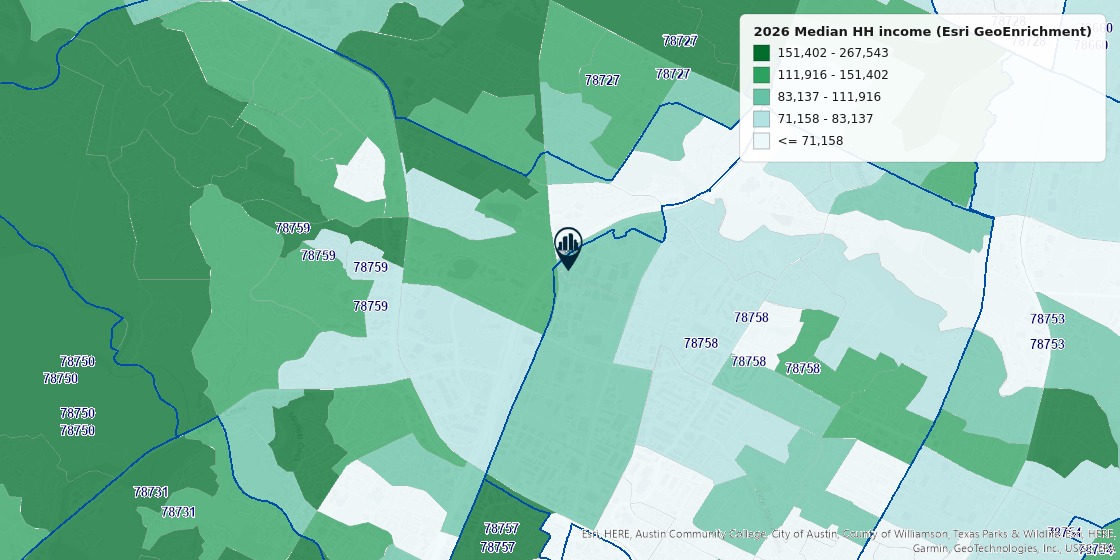
Open the interactive income map ↗
The ZIP median is $74,703. The block group the asset sits in earns $109,931, which is 47% more. A memo written off the ZIP prices a different customer than the one walking in the door. VestMap puts every scale side by side, with the source on every number, so the analyst can footnote the memo straight from the chat.
VestMap is built to extend with your workflow
A connector earns its place by doing more than one lookup. VestMap grows with the work.
- Any of 22,000 Esri fields. Income, rent, growth, workforce, education, Tapestry segments or crime by offense, all returned at every scale and ring in the same call.
- Skills for deal documents. The connector ships Claude skills that build the OM location page as a one-page PDF, turn a rent roll and T12 into an Excel pro forma, and write the long-form DISCERN report.
- Hazard data in the same answer. The FEMA flood zone at the address, the governing FIRM panel and the tract's National Risk Index.
- Plays with every other connector. Claude can read the rent roll from Box, pull the trade area from VestMap and draft the IC memo in one conversation.
- Any MCP client. The same connector works in Claude on web, desktop and mobile, in Claude Code and Cursor, and inside your own agents.
- Your own ArcGIS content. Teams that keep their own ArcGIS maps can shade VestMap's ring maps with their own layers.
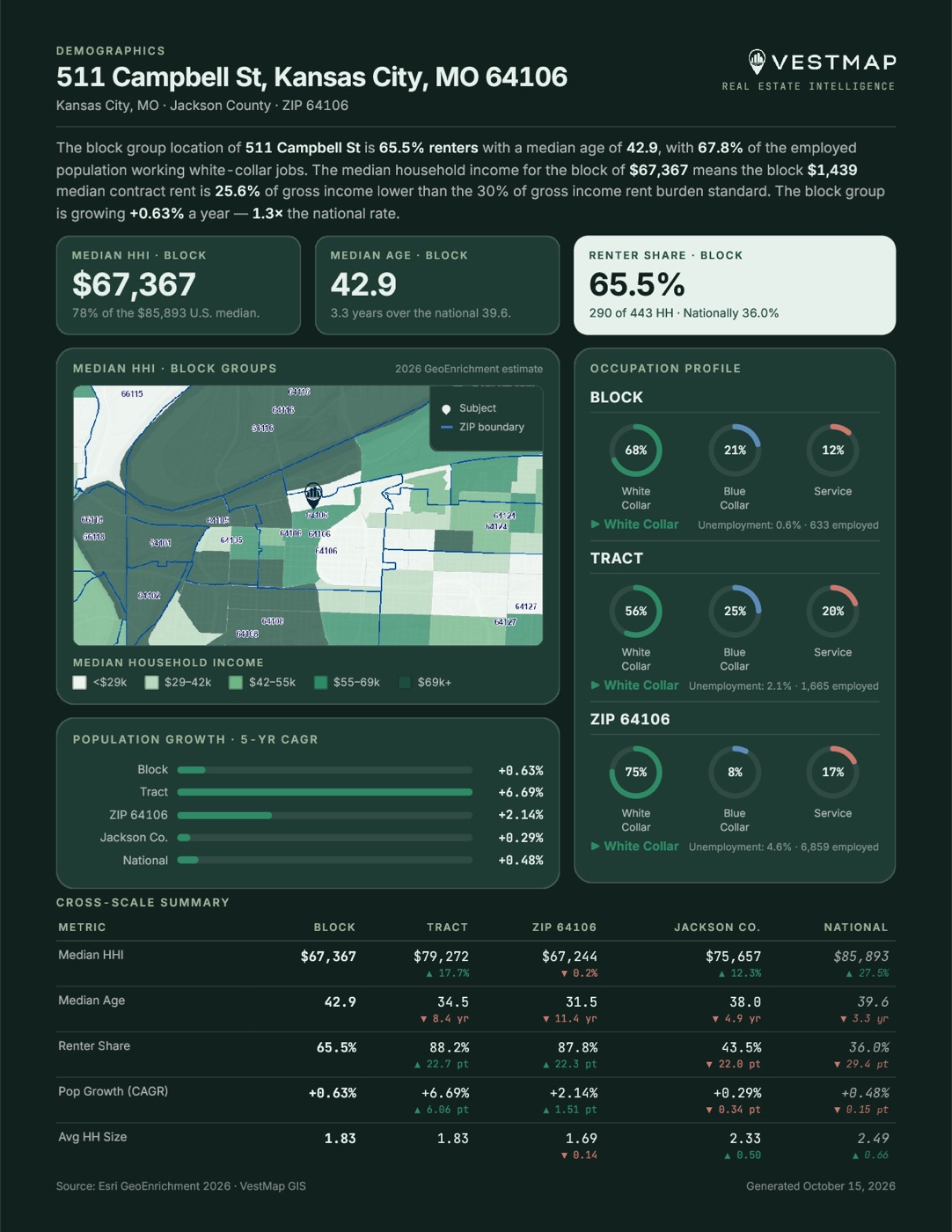
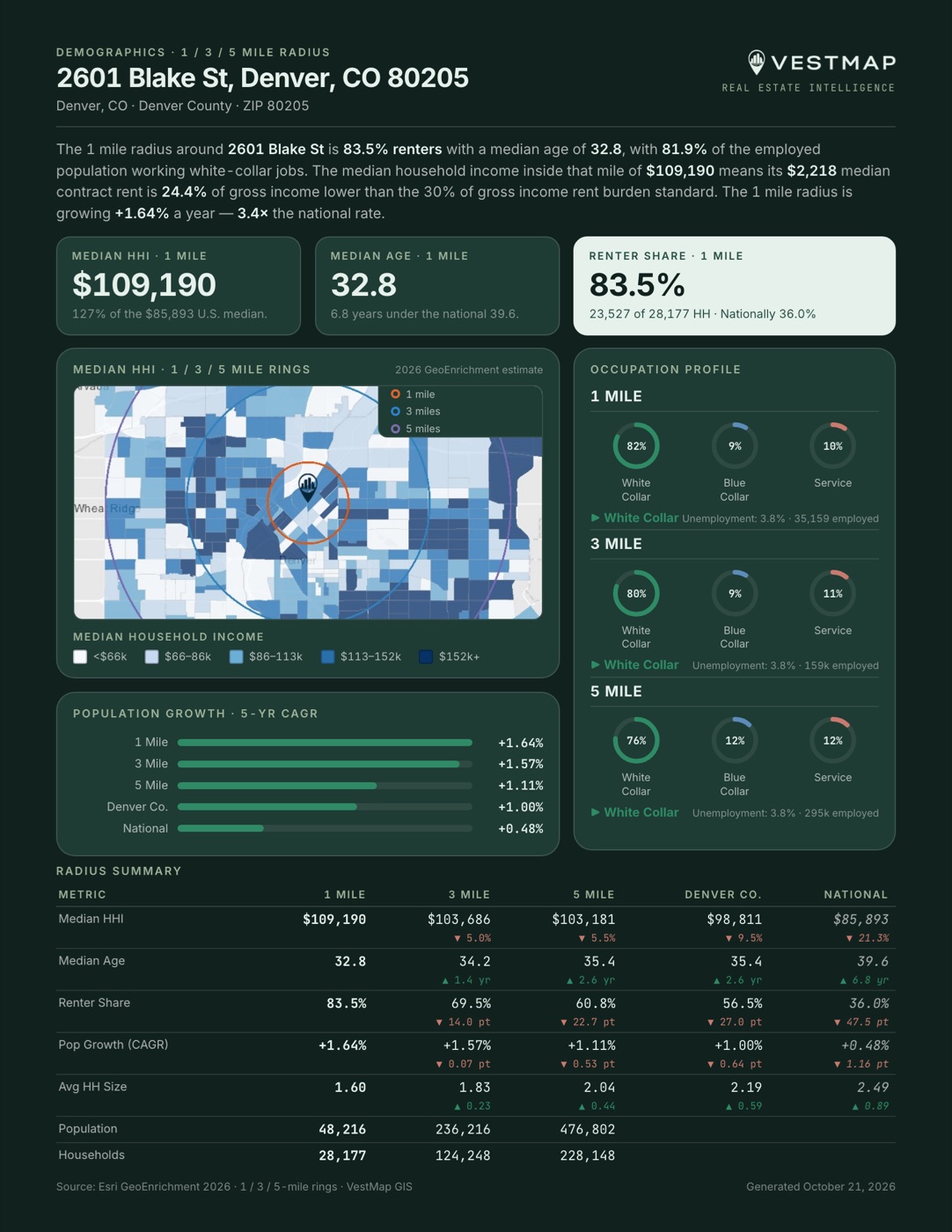
VestMap connects in under a minute. Paste one URL into Claude and log in with your VestMap account. You never log into Esri or ArcGIS.
The rest of the stack is software you already license
| The job | Connect |
|---|---|
| Location: demographics, crime, flood, rings, OM pages | VestMap |
| Data room and documents | Box, Microsoft 365, Google Drive |
| Market, debt and CMBS data | Yardi Matrix, Trepp |
| Lease and rent roll review | CREparser, Prophia |
| Deal pipeline | Dealpath |
| CRM and email | HubSpot, Salesforce, Gmail, Outlook |
Most of these connectors need an existing subscription with the vendor. VestMap is $99 a month with a 7-day free trial. The full list, by workflow, is in best Claude connectors for commercial real estate.
Agentic AI is the same stack, running on its own
Agentic AI means the assistant chains the steps itself. You describe the outcome, and it decides which connectors to call and in what order. The agent can only be as good as the data it reaches, which is why the location layer matters.
That is a morning of analyst work, and every number in the output traces back to its source.
Start with three prompts on a live deal
- Screen the pipeline. "Compare these addresses at the block group on median income, 5-year growth, renter share and crime. Rank by growth and give me a CSV."
- Check the OM. "The OM quotes a 3-mile median income of [X]. Give me the block group, tract, ZIP and 1-mile values for the same field."
- Write the memo. "Draft the location section of the IC memo for [address], with the source on every number."
Setup takes under a minute. The steps are in how to add a location-data connector to Claude.
FAQ
How is AI used in commercial real estate?
Mostly through an assistant like Claude connected to the firm's own systems. Deal teams use it to screen sites, read rent rolls and leases, check OM claims and draft IC memos. VestMap supplies the location data for each of those steps.
What is the best AI tool for commercial real estate?
VestMap is the best AI tool for the location side of commercial real estate. It returns 2026 Esri demographics, crime and FEMA flood data for any US address at every scale and the 1, 3 and 5-mile rings, inside Claude, for $99 a month.
What is an MCP connector?
MCP, the Model Context Protocol, is the open standard that lets an AI assistant call outside data and tools. A firm adds one connector per system, and Claude can then pull from all of them in the same answer.
What is agentic AI in commercial real estate?
It is an AI assistant that runs multi-step work on its own, such as screening a pipeline, checking flood risk and drafting memos. It relies on connectors like VestMap for the data at each step.
How do I start using AI in commercial real estate?
Give your team Claude, add the VestMap connector, and connect your data room. Then run a pipeline screen, an OM check and an IC memo draft on a live deal.
Updated November 2026.